Anatomy of a Creative Commons license
How do Creative Commons licenses work?
While our last posts gave an introduction to the context of
Creative Commons more broadly, this one will dive in to the details of the
Creative Commons (CC) licenses available. With a good knowledge of what the
licenses are and how they work, readers will be equipped to interpret CC licenses applied to other works they may
wish to reuse, and begin to consider the suitability of Creative Commons licenses for their own work.
Components of a Creative Commons license: The four license elements
Creative Commons licenses are made of four elements which are combined in various ways to make up Creative Commons licenses. Each element is unique and adds different restrictions to the work being licensed:
 The BY Attribution element prevents
the work from being redistributed or reused without attributing the creator.
The BY Attribution element prevents
the work from being redistributed or reused without attributing the creator.
 The NC Noncommercial element prevents
the work from being reused for commercial purposes.
The NC Noncommercial element prevents
the work from being reused for commercial purposes.
 The SA Sharealike element mandates
that those reusing the work do so under the same license as the original.
The SA Sharealike element mandates
that those reusing the work do so under the same license as the original.
 The ND Noderivatives element
prevents others from distributing works adapted or derived from the original
work.[1]
The ND Noderivatives element
prevents others from distributing works adapted or derived from the original
work.[1]
Creative Commons as Lego bricks: Combining the four license elements
If we have a good understanding of the four Creative Commons license elements, then without too much trouble we can understand the specifics of each Creative Commons license available.
Creative Commons licenses work by combining the restrictions of each license element together to create a license which provides only the restrictions desired by the creator.
Simpler, less restrictive licenses like CC BY Attribution only use one element. Longer licenses which combine multiple restrictions like CC BY NC SA Attribution Noncommercial ShareAlike are more restrictive and tend to discourage more types of sharing or reuse.
There are six combinations of the license elements which
make up the available suite of Creative Commons licenses:
CC BY 4.0 Attribution 4.0 International

This license allows others to share or adapt the licensed work as long as they attribute the creator of the original work.
CC BY-SA 4.0 Attribution-ShareAlike 4.0 International

This license allows others to share or adapt the licensed work as long as they attribute the creator of the original work and distribute any adaptations under the same license.
CC BY-NC 4.0 Attribution-Noncommercial 4.0 International

This license allows others to share or adapt the licensed work as long as they attribute the creator of the original work and reuse or redistribute it for noncommercial purposes only.
CC BY-NC-SA 4.0 Attribution Noncommercial Sharealike 4.0 International

This license allows others to share or adapt the licensed work if they attribute the creator of the original work, reuse or redistribute it for noncommercial purposes only, and do so only under the same license.

CC BY-ND 4.0 0 Attribution-Noderivatives 4.0 International
This license allows others to share the licensed work as long as they attribute the creator. However, it forbids others from distributing any adaptations of the work.

CC BY-NC-ND 4.0 Attribution-Noncommercial-Noderivatives 4.0 International
This license allows others to share the licensed work for noncommercial purposes as long as they attribute the creator. It forbids others from distributing any adaptations of the work.
Creative Commons non-license options: The two public domain tools
The following deeds are not licenses as the above options are, but instead are deeds which dedicate works to the public domain to the extent possible or mark the works as part of the public domain. Since there is no effective copyright to exercise, these works are not licensed under Creative Commons licenses, but are labelled with Creative Commons deeds to indicate their public domain status.

This deed cedes all copyright to the work in question, to the greatest extent possible under the relevant national contexts. This deed is used by creators who wish to renounce the copyright to their own work.

PDM 1.0 Public Domain Mark 1.0 Universal
This deed is used to label works which are already in the public domain and are free of known copyright restrictions. This can be used, for instance, to label books which are written by authors who are long-deceased and whose work has passed into the public domain. Since jurisdictions’ copyright laws vary internationally, those reusing the work should do so with attention to their own legal context to verify the work’s public domain status.
[All icons above are sourced from Creative Commons at https://creativecommons.org/mission/downloads/ and reused as per the Creative Commons Policies]
Creative Commons as lasagna: The layers of a Creative Commons license
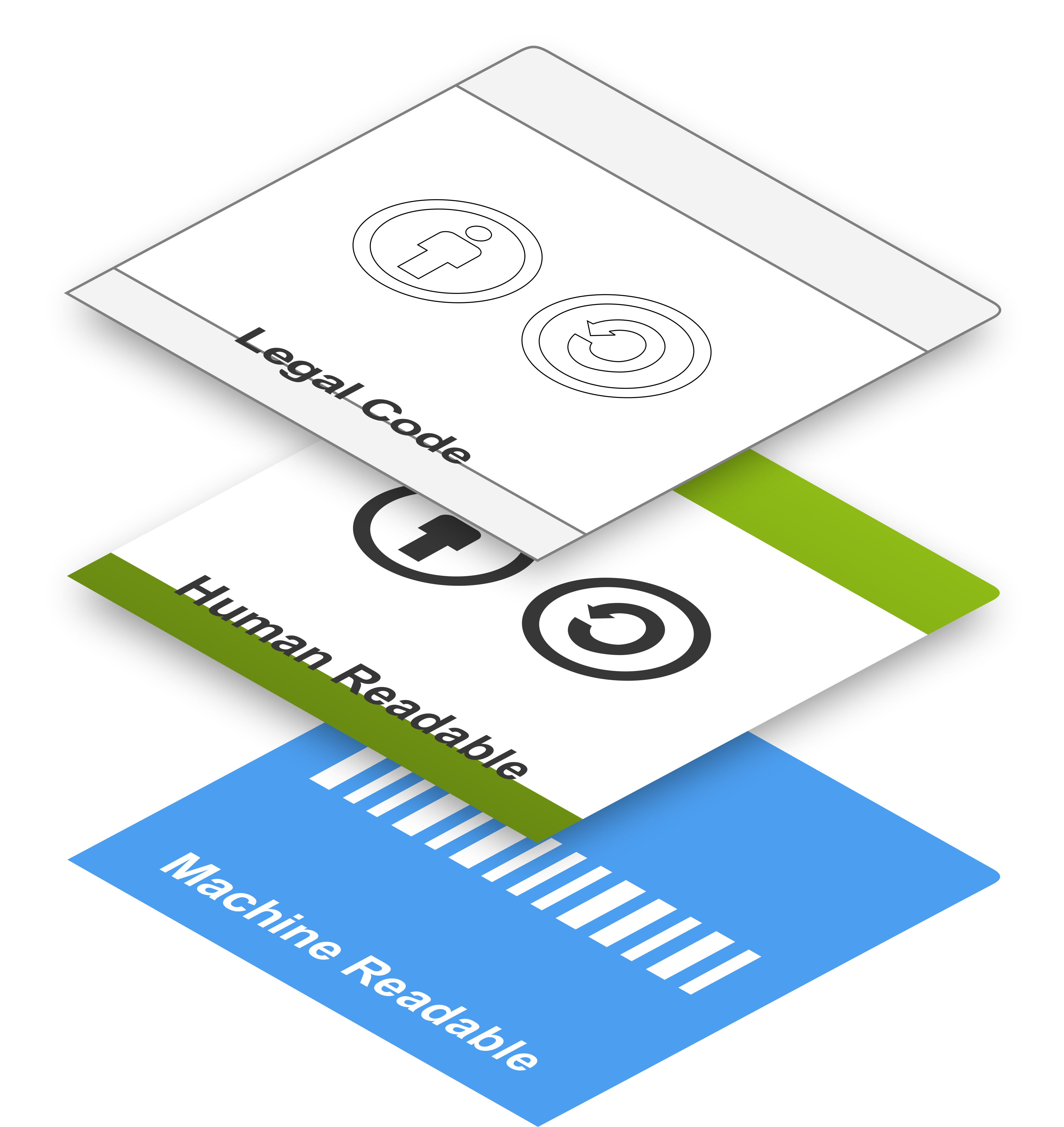
How do the Creative Commons licenses communicate their contents to users? A single Creative Commons license has three layers which present themselves as users investigate the license in further detail, as seen in Figure 1.

Figure 1: Three Layers of License (png). (Copyright 2011, Creative Commons, Nathan Yergler, Alex Roberts. Licensed to the public under CC BY 3.0 Unported.)
One of these is a human readable layer. This plain-language description provides information on the license beyond the license’s name and is intended to be broadly understandable to the public.
The next necessary layer is the legal code. While plain language license is readable by humans, this version of the license is written in legalese and is designed for lawyers – who may or may not in fact be considered humans, depending on who you ask. This provides the detailed text necessary to ensure that the license’s terms are valid and enforceable wherever it may be used.
The invisible layer of the Creative Commons licenses is the machine readable layer, articulated in structured metadata called the CC Rights Expression Language (CC REL). Associating structured CC REL with a published work will ensure that search engines and indexing services will be able to note the license associated with a work, and sort them accordingly.[2]
Another way of thinking about the layers of a Creative Commons license is as translated versions of the same text prepared for different audiences. One – the human readable version – speaks to creators and reusers of the work. The legal code speaks primarily to lawyers. Lastly, the machine readable version speaks to computers and automated services.
Scope limitations:
When using Creative Commons licenses, it is important to remember that copyright law is distinct from patent laws, trademark laws, and moral rights. As such, any relevant protections of trademarks, patent laws or moral rights are not changed by the application of a Creative Commons license. These considerations can become more complex than questions of copyright alone and may well merit legal consultation.
Conclusion
Creative Commons licenses simplify the process of posting material online intended for relatively open distribution. Users can easily select the terms under which they wish to share their work and select a Creative Commons license to match. The licenses provide an infrastructure for ensuring the legal enforceability of their terms, along with accessible interface to enable the ready selection of a license and ease interpretation by licensers, users, and information discovery systems worldwide
This post by Scott Cameron is licensed under a CC BY 4.0 Attribution license, and may be freely reused with attribution.
[1] Creative Commons. 2024. “About CC Licenses.” https://creativecommons.org/share-your-work/cclicenses/
[2] Creative Commons. (2024). “License Design and Terminology.” https://certificates.creativecommons.org/cccertedu/chapter/3-1-license-design-and-terminology/


Comments
Post a Comment